Efforts to minimize pauses during chest compressions, however brief, are important to successful outcomes. The evidence is strong enough for the American Heart Association Guidelines to give it a rare Class I recommendation.1
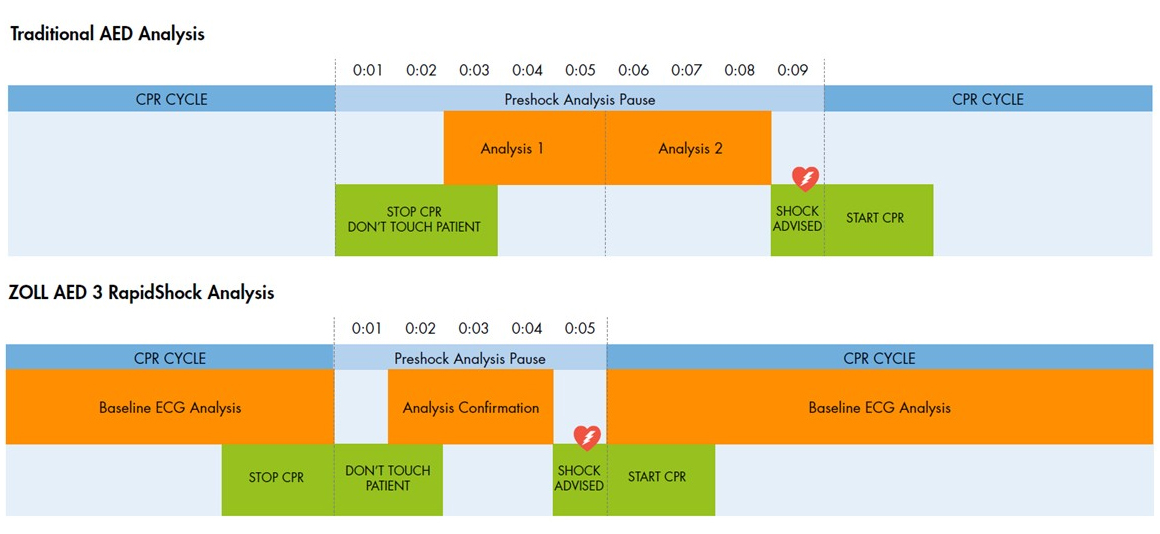
ZOLL’s RapidShock analysis algorithm gives rescuers the unmatched ability to significantly reduce pauses in compressions. RapidShock analysis performs a 3-second reconfirmation analysis, with the device already charged, enabling the delivery of the shock within 5 seconds.
Understanding Pre-shock Time Savings
Proven Technology and Demonstrated Accuracy
In retrospective studies, RapidShock analysis and quick decisions have demonstrated accuracy,2 exceeding the American Heart Association (AHA) standards for analysis algorithm performance goals as shown in the table below.
| RapidShock Performance Against AHA Recommendations3 | |
|---|---|
| Rhythm | RapidShock Performance |
| Coarse VF | Exceeds |
| Rapid VT | Exceeds |
| Normal Sinus Rhythm | Exceeds |
| Atrial Fibrillation | Exceeds |
| Sinus Block | Exceeds |
| PVCs | Exceeds |
| Asystole | Exceeds |
No matter where it occurs in a CPR cycle, interrupting chest compressions translates to “no flow” time. This is why ZOLL focuses on reducing the total pause time involved.
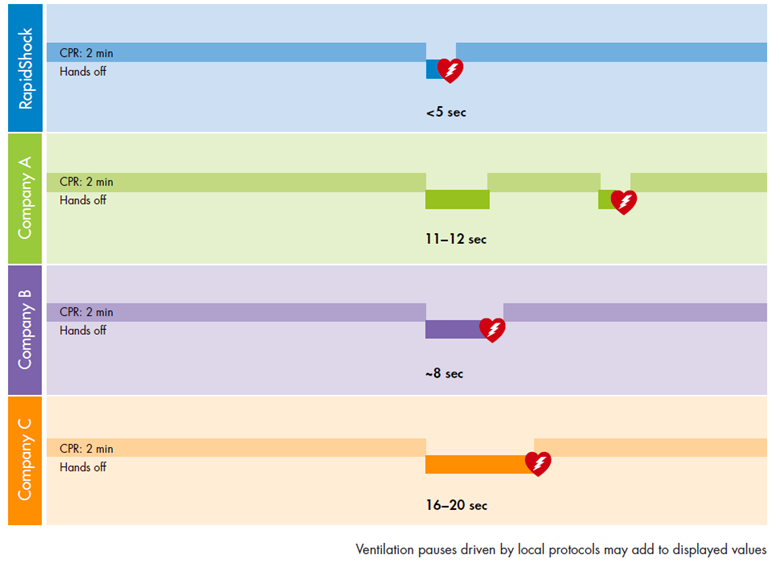
“...total preshock and postshock pauses in chest compressions should be as short as possible (Class I, LOE C-LD) because shorter pauses can be associated with greater shock success.”4
1 American Heart Association. 2015 Guidelines Update for CPR and ECC. Circulation. 2015;132:S318.
2 Fumagalli et al. Heart Rhythm. 2018;15:248.
3 Kerber R, et al. Automatic External Defibrillators for Public Access Defibrillation: Recommendations for Specifying and Reporting Arrhythmia Analysis Algorithm Performance, Incorporating New Waveforms, and Enhancing Safety, Circulation. 1997;95:1677-1682.
4 American Heart Association 2015 Guidelines (Page S-318)